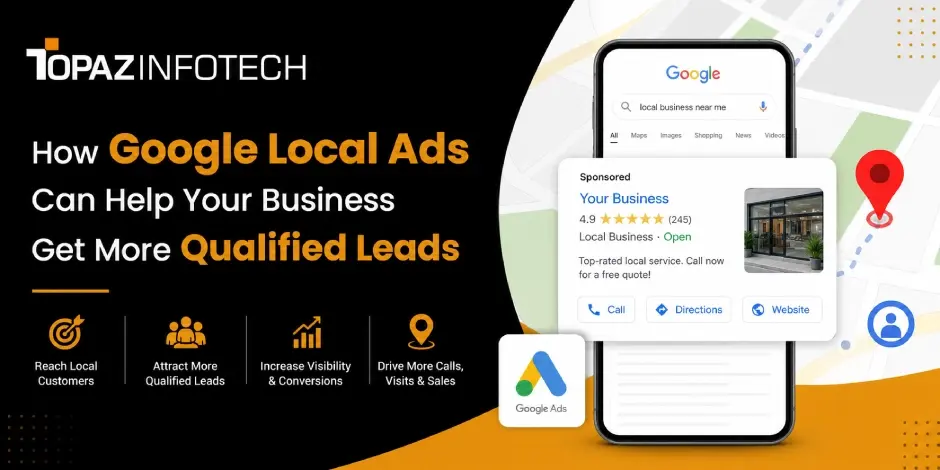
How Google Local Ads Can Help Your Business Get More Qualified Leads
A shop owner in Ahmedabad spends four hours a day answering calls from people who were never going to buy. That is the real cost of untargeted advertising, and it is exactly what well-run google ads services are built to fix. Local search ads put a business in front of someone typing "near me" with a wallet already open, and that single shift in targeting changes everything about lead quality.
Google's own data shows that 76% of people who search for something nearby on their phone visit a related business within a day, and 28% of those visits end in a purchase. Local ads exist to capture that intent before a competitor does. The rest of this piece breaks down how that works and what a business should expect from the process.
Google Ads services help a business get more qualified leads by placing paid listings in front of people who are actively searching for that product or service within a specific radius, using location extensions, call-only formats, and geo-targeted keywords so the ad only reaches users close enough and ready enough to convert into real customers.
Why Location Data Changes the Quality of a Lead
Location targeting narrows an audience down to people within a set distance of a business address, and that single filter removes most of the wasted clicks a broad campaign generates. A plumber running ads across all of Gujarat pays for clicks from cities he will never service. A plumber targeting a 15-kilometer radius around his shop pays only for people who could realistically become customers this week.
Google Ads lets an advertiser set radius targeting down to the kilometer, layer in location extensions that show the business address and a map pin, and add call extensions so a phone number appears directly in the ad. Each of these features exists because proximity is one of the strongest predictors of purchase intent in local search, stronger even than the keyword itself in many categories like food, repair services, and healthcare.
How Does Google Ads Targeting Actually Filter Out Bad Leads?
Filtering happens through a combination of signals, not a single switch. Google Ads cross-references a searcher's location, device, search history, and time of day against the advertiser's targeting rules before an ad is even shown, which means unqualified impressions get suppressed before they cost a rupee.
Dayparting is one underused piece of this filter. A restaurant that only takes orders between noon and 10 PM can turn ads off outside those hours, which stops the campaign from collecting leads nobody on staff can act on. Negative keywords do similar work on the search side, blocking terms like "free," "DIY," or "jobs" that signal a searcher has no intention of paying for a service.
Device targeting adds a third layer. Someone searching "electrician near me" on a phone while standing in a flooded kitchen is a far hotter lead than someone browsing the same term on a desktop at midnight, and Google Ads allows bid adjustments that reflect exactly that difference in urgency.
What Setup Actually Moves the Needle on Lead Quality
A handful of technical decisions separate a campaign that generates real leads from one that burns budget. The table below outlines the core levers and what each one controls.
| Setting | What It Controls | Typical Impact on Lead Quality |
|---|---|---|
| Radius targeting | How far from the business an ad shows | Removes unreachable prospects |
| Call-only ads | Whether the ad drives a phone call vs. a click | Filters out casual browsers |
| Negative keywords | Which search terms trigger the ad | Blocks free-seekers and researchers |
| Ad scheduling | Which hours the ad runs | Matches leads to staff availability |
| Location extensions | Whether address/map data shows in the ad | Builds trust before the click |
Working with a google ads specialist India businesses trust usually means these five settings get configured together rather than one at a time, since they interact. Turning on call-only ads without adjusting bid strategy, for instance, often produces fewer but far more qualified calls, and that trade-off needs to be planned rather than discovered by accident three weeks into a campaign.
Building a Campaign Structure That Supports Real Leads Over Time
Campaign structure matters as much as targeting once a business moves past the first month of running ads. Grouping keywords into tight ad groups, each built around one service or product line, lets Google match search intent to ad copy with far more precision than a single catch-all campaign ever could.
A dentist advertising "root canal," "teeth whitening," and "dental implants" inside one broad ad group will see mediocre performance across all three, because the ad copy can only speak to one intent at a time. Splitting those into separate ad groups, each with its own headline and landing page, routinely improves click-through rate and, more importantly, improves the percentage of clicks that turn into booked appointments.
A google ads expert India companies rely on will typically rebuild this structure within the first two to three weeks of taking over an account, because most underperforming campaigns share this same root problem: too many unrelated keywords crammed into too few ad groups.
Why Ongoing Management Beats a Set-and-Forget Approach
Search behavior shifts constantly, and a campaign optimized for January rarely performs the same way by June. Seasonal demand, new competitors entering the auction, and changes to Google's own algorithm all move the cost per click and the conversion rate on a rolling basis, sometimes week to week.
A business checking its account once a quarter will miss most of these shifts until the budget has already been spent inefficiently for months. Weekly review of search term reports, bid adjustments, and landing page performance is what separates accounts that improve steadily from ones that plateau after the first strong month.
This is the main reason many businesses eventually hand the work to a full-time google ads agency India teams work with, rather than managing it internally alongside a dozen other responsibilities. Consistent, weekly attention to the account is close to the single biggest predictor of long-term lead quality, more than any individual setting discussed above.
Conversion tracking is the piece that makes all of this reviewable in the first place. Without it, a business is guessing at which keywords or ad groups actually produced a phone call or a form submission, and every optimization decision after that becomes a shot in the dark rather than a data-backed adjustment.
Frequently Asked Questions
Where This Leaves a Business Ready to Act
Local intent is the closest thing to a guaranteed customer that digital advertising offers, and Google Ads services exist specifically to capture it before a competitor's ad does. The businesses that treat their account as something to configure once and forget rarely see the return the platform is actually capable of producing.
The ones that review search terms weekly, split campaigns by service line, and adjust for the hours their team can actually respond tend to see lead quality climb steadily rather than spike and fade. Start with one tightly targeted campaign, measure it honestly for a month, and expand only what the data proves is working.